
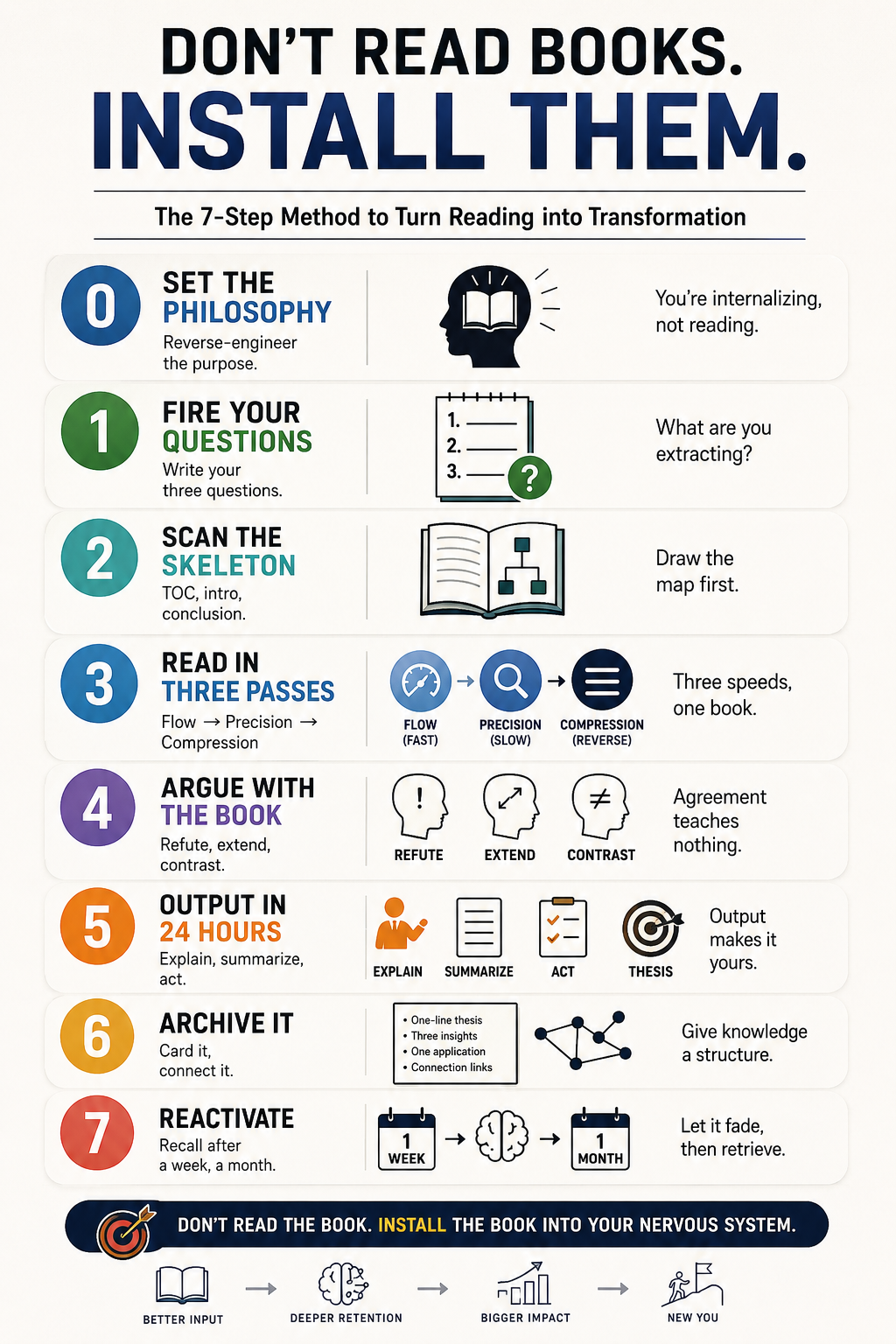
“Many people read books. Few make books their own. The difference is never talent — it’s method.”
I don’t read books for information. I read books the way an engineer installs code into a system: deliberately, structurally, and with one clear goal — that the book’s core operating logic becomes part of my thinking by the time I close it. A week later, it should show up in how I decide and act.
This is the complete reading method I use, broken into seven steps. Even a rough imitation of it will dramatically increase how much of a book you actually retain.

Step 0: Set the Philosophy — You’re Not Reading, You’re Internalizing
Most people misunderstand reading. They treat it as the act of accumulating knowledge, so they finish a book and move on. A book on your shelf that you’ve “read” but can’t recall isn’t read — it’s owned, like furniture.
My reading philosophy comes down to a single sentence:
- The purpose of reading is to make the book’s core work inside my life.
That one sentence decides everything that follows. Whether I read fast or slow, take notes or skip them, read it once or three times — every choice is reverse-engineered from this purpose. Reading without a purpose isn’t learning. It’s burning time.

Step 1: Fire Your Questions First — What Are You Extracting?
Before I open the first page, I always write down three questions.
- What problem is this book trying to solve?
- Is that problem my problem — right now? (Or is it someone else’s?)
- After I close the book, what has to change for me to honestly say “I read it”?
The third question is the most important. “What has to change” becomes your reading KPI. The goal isn’t to finish the book. The goal is to move one step forward in your life because of it. If you finish 300 pages and nothing shifts, you didn’t read — you skimmed.
Clear questions do something else quietly powerful: they tell you where to read deeply and where to skim. You stop treating every sentence as equal.
Step 2: Scan the Skeleton — The Table of Contents Is the Map
Before touching the body of the book, I spend 10 to 15 minutes mapping its structure.
- Read the table of contents twice — once for the flow, once for the logic
- Read the introduction and conclusion first (lock down the author’s final claim before anything else)
- Skim only the first and last paragraph of each chapter
The point is to build a mental map before you start. When information has a place to land, it sticks. When it doesn’t, it slides off. You don’t remember pages — you remember structure.
Never attempt to finish a book whose table of contents you don’t understand. You’ll reach the last page having retained nothing.

Step 3: Read in Three Passes — Don’t Try to Get It All at Once
I read the same book at three different speeds. (Not every book earns this, but the ones that matter do.)
Pass 1 — The Flow Read (Fast)
Goal: Capture the overall arc and 3 to 5 core arguments. Read at 2–3x your normal pace. Anything you don’t understand, just mark and keep moving. The rule is simple: never stop. Stopping kills momentum, and momentum is what carries you to the author’s main point.
Pass 2 — The Precision Read (Slow)
Now go back to the sections you marked and the ones tied to your reading KPI. This is where you underline, where you write questions and counterarguments in the margins, where you actually argue with the book. This is the pass that turns reading into a conversation.
Pass 3 — The Compression Read (Reverse)
Skim the book backwards and extract only the skeleton. The pass is done when you can compress the entire book into a summary of three pages or less, in your own words. If you can’t write it in your own words, you haven’t read it. You’ve only been exposed to it.
Step 4: Argue With the Book — Agreement Is the Enemy of Learning
The most dangerous way to read is in a constant state of nodding. “Yeah, that’s right” lets a sentence pass through you, and three days later it’s gone. What stays is friction. Conflict.
While reading, I constantly fire three challenges:
- Refute it: “Is this actually wrong?” — Force yourself to find even one counterexample.
- Extend it: “How would this apply to my field?” — Move the book’s principle into a different domain.
- Contrast it: “How is this different from what I already know about X?” — Set it against your existing knowledge.
The moment these questions fire, the content binds to your knowledge network — and only bound knowledge is retrievable. Everything else leaks.

Step 5: Output Within 24 Hours — Unspoken Knowledge Isn’t Knowledge Yet
This is the heart of the method.
Within 24 hours of finishing, I force output. The format is flexible:
- Explain it to someone (the most powerful — you only truly know what you can teach)
- Post a 3-line summary on a blog or social channel
- Turn the book’s core into one concrete action plan you’ll apply to your own situation
- Compress it into a single thesis sentence and write it in your notes
Reading without output is an undigested meal. The nutrients never get absorbed.
One pass of reading followed by output beats three passes of reading followed by silence — every time.
Step 6: Archive It — Knowledge Only Grows Inside a System
I never just “record” that I read a book. Each book becomes a card in my knowledge vault, and every card holds four things:
- One-line thesis: the book’s core in a single sentence
- Three insights: the three takeaways I actually gained
- One application: one thing I’ll do differently because of it
- Connection links: ties to other books and notes on the same theme
As the cards stack up, a network forms between books. Reading a new book automatically reactivates the old ones. This is reading with compound interest — not just reading more, but reading faster and absorbing more with every book. The system gets smarter, not just bigger.
Step 7: Let It Fade, Then Retrieve — Deliberate Forgetting
The brain is built to forget. Fighting that destroys the whole process. So I do the opposite — I let forgetting happen on purpose.
- After one week: look at only the book’s title and try to recall the three core ideas. Whatever doesn’t come back was never really yours. Open the card again — only for those.
- After one month: read only your one-line thesis and try to explain the entire arc out loud.
This “forget → retrieve” cycle is what cements knowledge into long-term memory. You’re not fighting the forgetting curve — you’re weaponizing it. You don’t rehearse constantly to avoid forgetting. You let it fade, then pull it back at the exact moment retrieval is hardest. Far less effort, far deeper retention.

Quick Reference: The 7-Step Method
| Step | Core Action | In One Line |
|---|---|---|
| 0. Set philosophy | Reverse-engineer the purpose | You’re internalizing, not reading |
| 1. Fire questions | Write your three questions | What are you extracting? |
| 2. Scan the skeleton | TOC, intro, conclusion | Draw the map first |
| 3. Read in three passes | Flow → Precision → Compression | Three speeds, one book |
| 4. Argue with the book | Refute, extend, contrast | Agreement teaches nothing |
| 5. Output in 24 hours | Explain, summarize, act | Output makes it yours |
| 6. Archive | Card it, connect it | Give knowledge a structure |
| 7. Reactivate | Recall after a week, a month | Let it fade, then retrieve |
One Last Thing: How to Choose a Book
No method survives bad input. Read garbage, retain garbage. When I choose a book, I check three things:
- Has it survived time? — Is it still being cited 10, 20 years later?
- Has the author actually done it? — Theory sellers are easy to spot. Practitioners write differently.
- Does it touch my KPI? — Does it connect to the problem I’m trying to solve right now?
One book that passes all three beats twenty that don’t. Quality over quantity. Internalization over completion.

The entire method collapses into one sentence:
Don’t read the book. Install the book into your nervous system.
Reading is only the starting line. The seven steps — questioning, mapping, arguing, outputting, archiving, and reactivating — are what turn a book into capability. Stack enough capabilities this way, and within a year you won’t just know more. You’ll think in a fundamentally different system than the person you are today.
Reading doesn’t end with reading. Reading is the input device for self-reinvention. Pick one book today and run it through this method. The difference in a single book will be unmistakable.
Leave a Reply